Total Pageviews

Sunday, 24 September 2017

So Long, My Tiny Cabin in the Woods!

As summer comes to a close, the red and yellow leaves and early sunsets are sneaking in. A sign of change ahead.
Welcome to my sleepy cabin in the woods
I'm now entering the last week of my 4 months living in my little cabin in the woods. And what a special 4 months it has been. Time flew by, and the time that passed felt quite busy. But not in the conventional sense of busy-ness, running from one commitment or errand after another, and constantly running behind.

I did have a job that kept me quite busy, running a fairly conventional schedule of Monday to Friday 9 am to 6 pm. But I had one of the best commutes anyone can ask for. Every morning I walked 10 minutes through forest and meadow to the opposite end of my boss's property. Some days I would take the route by mountain bike.

My sweet commute 


I watched as my meadow was dominated by different colours throughout the season, from the white of Queen Ann's Lace to the purple of Ragged Robin, and recently to the yellow of Goldenrod. I picked wild strawberries and yarrow, and observed the occasional painted turtle and snake along my commute. A few nights a week, I would hear the ramblings of a porcupine, poking around the vicinity of my cabin.

I worked with my boss Simon (at Instagram preservingearth), absorbing the steep learning curve of not just carpentry, but timber framing, which is on a final boss level of difficulty. I made many mistakes along the way, but Simon was unwavering in his patience and confidence in me to grow from these mistakes.

Simon and a special axe
Me and a big circular saw
Our workshop could be the most beautiful work environment to do carpentry. It was actually a large greenhouse which let in tons of natural lighting, but had overhead tarps for shade. And it had roll up windows to allow for a cool breeze to push out the heat, providing relief from the omnipresent sawdust. Some days it felt like I was working outdoors.

Mingled in to the work were long conversations about philosophy, society and permaculture, and listening to podcasts on similar matters. It was a nice coincidence to discover that Simon was among few people who matched my passion for intellectual conversation, and our values and life experiences complemented eachother very well.

After work, I would bundle up several ice packs from Simon's fridge, and commute home through the meadow and forest, back to my sleepy cabin. I would deposit the ice packs in my cooler box, then go for a skinny dip in my pond, occasionally soaping off the beads of sawdust and sweat that my body accumulated throughout the day.
Skinny dipping not photo optional
Notice I fixed the dock?
Once clean (or at least my version of it) I would prepare dinner, usually a mix of dumpster dived foods, foods given to me by my family, and vegetables from a local weekly CSA. I would usually listen to a podcast while preparing and eating dinner. After dinner, I had many options, but would usually sit by my dock and read or practice guitar.

Wifi and connection to the real world was reserved for weekends at the awesome Garafraxa Cafe, where the owner will give anyone a chance to play music. Thus, I was practically in my own little bubble - picture one of those snow bubbles in the souvenir shops, but with my little cabin and me. There's no better place to be at peace and just think, which is my favourite activity in the world.

Recently, with the sun setting as early as 8:30 pm, I've been having lots of fires by the pit beside my pond, while practicing guitar. Then I would sit by my pond admiring the stars in the sky, until my melatonin slowly took me over and dragged me to bed, where I slept better than anywhere else in my life. No noise. No light. No distractions.

My friend Kyris Music, escaping bustling Toronto, enjoying my slice of the woods
Some family time around the campfire

The original plan was to finish the timber frame and raise it into place with a crane by end of September, then apply straw bale for the walls, a natural and sustainable building material. A little past halfway through my time there, that deadline had to be pushed back to past winter and into late spring of 2018. Once this decision was made, I felt the weight of the stress lift off our shoulders. 

Thus, work pushed on, but without that looming deadline. Work was never boring, or lacking in conversation. We rode the roller coaster of emotions from the changing schedule through an exceptionally rainy summer, and emerged into a smooth September. And into my last week here on the job, I feel (and I hope Simon does too) that this will mark the end of a pretty special time in our lives.

On a personal level, I am feeling more powerful than ever. After quitting my engineering job 3 years ago, I now finally feel I have broken clean of the rat race and the whole paradigm that follows it like an inescapable shadow. After my spiritual quest which ensued, through primarily travel, in which I healed myself with love and nurtured my inner confidence and inner strength, this was the summer for me to begin channeling my spiritual energy into practical creation.
Simon's cat - Marty McFly
Looking forward, I bring with me a knowledge of carpentry, as well as a bundle of knowledge in my head, and energy in my hands, ready to fusion in to something real and tangible. In the long term, that means being self employed in a field of sustainability. In the shorter term, it means more blogs for you!

But for the rest of 2017, it's time to escape back into travel. South America, here I come! (more details to come, obviously)

PS. a big thank you to Simon, Talia and Shea for sharing their beautiful property, their time and wisdom with me

Sunday, 30 July 2017

Run Back to the Wild: Part 2

Part 1 of Run Back to the Wild provided a general overview of how modern civilization is divorcing itself from nature, and how this is deteriorating our health. Part 2 goes into a few basic aspects of human health, and how returning to our ancestral roots can help us recover our health where modern living has undermined it. I try to weave my own experiences, living in the woods, into the picture.

So, without further ado:

Better sleep - since moving in to the cabin, my sleep has improved dramatically. And since listening to a podcast about sleep, I am learning about the multi-faceted reasons why I am sleeping better, and the magical driver behind it all, melatonin.

Melatonin is a hormone produced by the pineal gland, in cadence with our circadian rhythms. It is classified as an antioxidant with surprising health effects. And research shows that regular exposure to the daily cycle of light (particularly sunlight) and dark, as well as fluctuations in temperature, stimulate healthy production of melatonin, which enables sleep.
Sleeping in nature puts us closer to our natural sleeping rhythms
Our modern lifestyle has interfered with melatonin production in several ways. During the day, we spend too much time indoors exposed to artificial light, not bright enough to tell our bodies it's day time. And at night, we spend too much time in front of screens, which emit a blue light, which is too bright to tell our bodies it's dark. In addition, temperature regulated houses remain too constant throughout the day, and too hot at night, given that our bodies prefer sleeping in colder than room temperature.

You may be surprised to know that our hunter-gatherer ancestors actually slept about the same amount of hours as modern humans. But they stayed up with the campfires, moon and the stars, which emit a different colour on the light spectrum, which still let their bodies know it's dark out, stimulating the melatonin production they need for better quality sleep and health.

There are so many unbelievable benefits to melatonin as well as sleep, so I'm really happy to be sleeping well in an environment exposing me to natural daily fluctuations of ambient light and temperature, and without screen based distractions.

Eat natural - "eat what your grandparents ate", as my favourite food author, Michael Pollan, says. This is much more achievable than, say, eating like our hunter-gatherer ancestors ate. They ate a wild diet of foraged flora and large mammals, rich in high quality fats and nutrients, sufficient in calories. By contrast, modern humans eat a calorie excessive diet low in quality, causing illnesses such as cancer, to explode in the modern era.

Our bodies evolved over millions of years to eat wild, undomesticated foods. They are not evolved to handle the chemicals and preservatives in today's processed foods, or genetically modified foods for that matter. Studies are exposing the long term effects of accumulation of such chemicals in our bodies, as a direct result of our diet.
Wild strawberries on my boss's property - so sweet!
Another useful comparison to make between our ancestors' eating habits versus modern humans, is the quantity and frequency of food consumption. We eat much more, and more frequently today, which puts a lot of stress on our metabolic engine. Imagine revving the engine of your car constantly - eventually, the engine will burn out. Modern dietitians are promoting eating 5 times a day, but I say eat less.

On the other end of the spectrum is fasting. This habit is present in many religions and traditional cultures. Science shows that fasting actually helps our brains build connective tissue, like a hermetic stressor, in the same way that exercising tears our muscle fibres, allowing them to rebuild stronger than before. The hypothesis is that, when our ancestors got hungry, they needed to think about where to hunt or gather their next meal. As long as such habits do not become chronic, they remain acute or hermetic stresses, which stimulates the body in positive ways.

If you're not ready to try fasting, say one day, or even one meal a week, simply take snacking out of the scenario. I've fasted on a few occasions to varying degrees, and feel much more mindful and alive whenever I do it. Plus, I'm no longer a slave to my hunger.
A modest breakfast by my pond
Most of us really overthink and complicate what we eat, which is understandable because what we put into our bodies is probably the most important factor affecting our health. But the focus is misplaced on getting certain nutrients and avoiding others, when it should be on eating organic, unprocessed foods. The processing of foods takes on many variations, but essentially, if it's boxed or packaged, it's undergone some form of processing.

Eating what your grandparents ate, and eating just enough, is advice that is so simple and sensible, and erases the complexity of arranging our lives around fad diets, and focusing on, or off, specific nutrients. 

Looking back to our grandparents, and further back to our wild ancestors, it's time to turn the tables, and the clock, back on this food paradigm.

Unplug your Phone, Plug into Nature - worry less and de-stress! Studies show that being in nature lowers our cortisol (stress) levels. On the technology side, studies show that social media makes us less empathic and more self centred. School children are getting addicted to screens, which is reducing their attention spans and sleep hours. I've already mentioned the screen's effects on melatonin production and sleep.
I live here!
Some say there is literally something in the air in the forests, a mixture of microbes created by the trees and plants, that relaxes us. Whether that is true or not, we don't need science to tell us that. We know it just by doing it - just by being in the forest.

Or perhaps some of us don't know it right away, but once we start doing it, or once some of us get over the initial fears and discomforts of being in wild settings, we start to realize the differences between being in the forest versus the city.

Forests are tranquil, beautiful, calming, healing... the list goes on.

Forests are virtually void of any stresses, save the nagging discomfort of walking on uneven ground or, good heavens, getting dirty! The air is clean, the noises are musical, and the stimulation is intoxicatingly pleasant. In sharp contrast with social media, being in forests fosters humility through a feeling of awe, surrender to beauty, and interconnectedness with our natural surroundings. Being in forests slows life down, brings us back to the present, lets us forget about our worries, and dissolves our consumer attachments.
Meditating in the middle of my pond
Come slackline with me!
Again, this is not a black and white concept, and I'm not saying that screens are bad. But as the human race is gravitating towards urban environments, it is becoming further disconnected from green and natural spaces, and more and more hooked to screens. A better balance needs to be restored.

As for me, I get my screen time on weekends, but I try to keep that a second priority to my awesome life in the woods (by the way, friends in Ontario, why haven't you visited me yet?).

Walk barefoot - anyone who has spent significant time with me would know that I'm a huge advocate of going barefoot. Barefoot shoes have improved my physical health and changed my life.
Bare foot at a little concert
The human skeleton is evolved to strike any surface - whether textured like the ground, or flat like sidewalks,  flat-footed, without cushioning. The modern shoe contorts our feet into unnatural positions, changing our gait and altering how our bodies absorb the upward forces from walking and running. Cushioning in shoes (including arch support) has not eliminated these upward forces, merely dulled the pain. Over time, these upward forces act as chronic stress on our bodies, creating chronic pains and injuries that are difficult to reverse.

The episode of Nature of Things - The Perfect Runner wonderfully describes how humans evolved out of trees to become bipedal and run long distance in order to hunt animals. It describes the physics of running, and how modern cushioned shoes have altered those physics, atrophied the muscles in our feet and cramped our posture. I would also recommend the amazing and inspiring book Born to Run.

I'm not suggesting that everyone should try this, but that most of us overlook the potential of our bodies to rebuild its form around a more natural way of walking and running that aligns with our evolved physiology.

*~*~*~*

Some of these solutions for minimizing chronic stress and living healthier are startlingly simple. They are simple because they are rooted in our ancient culture and our ancestral DNA. Our hunter-gatherer lifestyle may be in the past, but in the grand perspective, it really wasn't that long ago, and many of the lessons from that lifestyle still hold true today.

Much of the information in this blog is inspired by the amazing podcast Rewild Yourself. Everybody needs a little more wild in them.

Run Back to the Wild

The name of my blog are lyrics from the song To The Wild by the band Mother Mother. Although it's obviously a very extreme statement akin to giving up everything we know to be true and returning to cave dwellings, it feels strangely appropriate given how swallowed up some of us are in modern living, and how our modern culture is contributing to many of today's pressing issues.

I have now been at my job for two months, building an off grid house with timber framing construction. I have spent those two months in a cozy cabin at the opposite end of my boss's property, nestled in cozy isolation by a small pond and the cedar forest.
That's one hell of a big saw
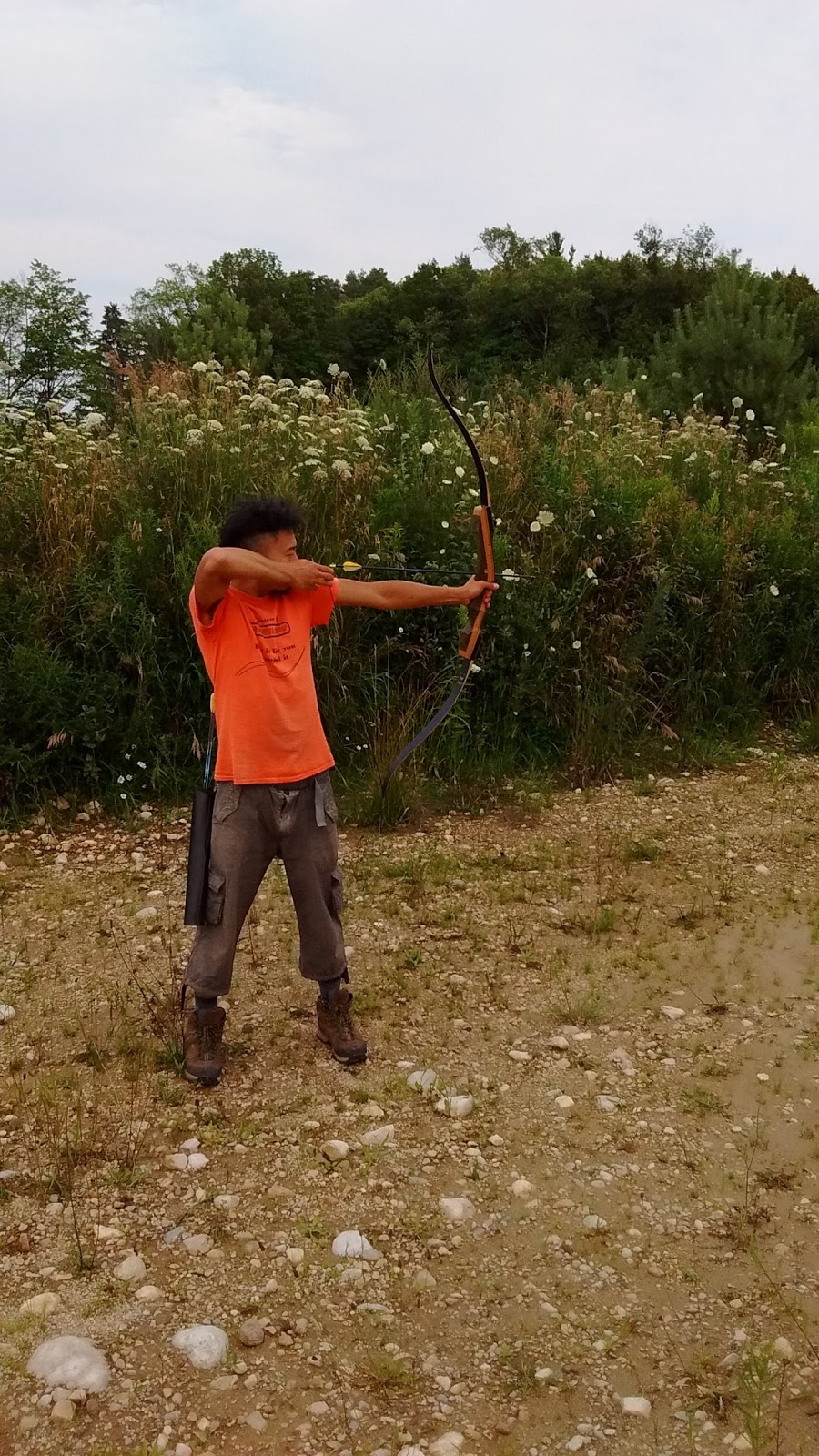
Trying archery for the first time!
In those two months, I have gained wisdom and insights, both experientially and intellectually, towards living more wild. Living in the woods and working with wood, learning carpentry under the tutelage of an inspiring and gentle human being has been incredibly rewarding. In the midst of the work days, my boss Simon and I share intellectual and philosophical conversations and listen to tons of educational podcasts, which adds some texture to the work day.

I want to share some very basic insights I've learned with you. That which I share reflects my personal beliefs and philosophies, and are not stated as truth or dogma. My simple hope is that, if you are willing to read, you are open to what I have to share, which I do for the pureness of sharing, and without evangelism or condescension.

*~*~*

We are born into the world and know it from the most basic perspective: our own. But that perspective is very limited in time and consciousness. When we see people living differently from us, we wrongly apply what we know about our own life to their situations, and see their perspectives as different and somehow wrong. Similarly, we learn about people living from a different time in the past, and we see it as primitive and un-cultured.
What is normal in India is simply out of the question in western countries. But is it wrong? Would you do it?
But take a bigger perspective, one that reaches beyond our own consciousness or perception of time, and we see how short sighted the way we live is.

If the Earth's history was condensed into a 24 hour day, humans would have emerged with just over 1 minute remaining in the day. And the emergence of agriculture and our modern civilization? A matter of seconds remaining in the day. Nature has had millions upon millions of years to evolve and create a habitable environment for complex organisms such as mammals. Humans took millions of years to slowly evolve to that environment, culminating in the cultural lifestyle of hunter-gatherer. This culture lived generally in a harmonious way with its environment, existing for at least 1.8 millions of years in this way (genus homo erectus).

Fast forward to today, and now more than half of the human race is living in an environment of asphalt, concrete and virtual screens, shut out from the environment we are naturally adapted to. Technology is changing our habitats much faster than humans can biologically evolve to adapt to it, creating all sorts of health issues, while pushing the natural environment to its limits.

So what should we do about it? Run back to the wild?

Well, yes. And no.
Getting in touch with my wild side - northern BC

The answer is not so straightforward, but essentially we need to find a better balance. While science is pushing frontiers of what humans can accomplish, study after study is exposing the human body's limitations to certain advancements. Study after study is also showing how living closer to our hunter-gatherer ancestors will put us in better balance with our environment, improving our health.

The human body is an amazing creation, the product of millions of years of evolution. It has an array of natural defenses designed to fend off illness and disease. The human body uses these defenses to maintain homeostasis, which is the tendency to maintain internal stability, by responding to stimuli.

Technology is undermining homeostasis in two ways. It is exposing our bodies to pollutants and chronic stresses which our bodies are not evolved to fend off. And it is shielding us from natural stimuli which prevent our bodies from developing its natural defenses, weakening them in the process.
Green clearings are essential in our sprawling urban jungles - Vancouver, BC

It can be argued that technology has come up with countless ways of improving our health, and that humans are living longer as a result. But countless scientific studies are showing that modern technology may be providing us with only short term solutions that are instantly gratifying, minimizing symptoms and providing comfort. Over the long term, these technologies are deteriorating our health.

In Part 2 of the blog, I will go into detail into some of the aspects of human health, how living more like our wild ancestors can actually restore our homeostasis and our health, and how my own experience in the woods has validated these insights. Link here

Sunday, 2 July 2017

Confessions of a Dumpster Diver

I’ve been dumpster diving for almost the entire past half year in Ontario now. But I started dumpster diving about four years ago and have been doing it off and on since then. This has become more than just another hobby for me. I’ve gained a lot of insights about myself, and about society. I've occasionally dived for non-edibles, but I will be focusing my blog on edibles, as food waste is such a big issue.


Gees Louise! Kashi cereal, Kettle chips, granola bars, and more

Dumpster diving is a journey in itself. When one begins there is a feeling of fear and shame, quickly replaced by liberation. When I started doing it, I was afraid of being caught, afraid of people judging me, and feeling a bit like a bum. After awhile though, my shame gave way to freedom, and then enthusiasm.

The enthusiasm has multiple dimensions to it. Obviously, free stuff rocks! Then, every time I open a bin, I feel the thrill of never knowing what I'm going to get. Sort of like playing the lottery or, as Forrest Gump said, opening a box of chocolates. Some days I get nothing, some days I score big and I feel like I won the lottery!
Found these chocolates (not expired) shortly after Valentine's Day and Easter.

Then there's the realization that most of the food I find is actually in good shape. Packaged goods are typically thrown out due to exceeding the 'Best Before' date, although I've discovered a variety of other trivial reasons, such as torn or dirty packaging, or going out of season, such as holiday chocolates.

With produce, such as fruits and vegetables, a surprising amount of what I find looks completely fine, like something I would buy in the store. Some produce may have soft spots, or some surface imperfections, but are otherwise perfectly edible.
Apples. Lots of apples. And they're all perfectly fine.

Various fruits and veggies

The bread basket. I simply avoid the products touching the sides of the bin

Most spots are free and clear. Occasionally though I run into other divers!

This realization triggers elation for my tummy, but disgust for the food industry. Every time I dumpster dive I lose a little more faith in our economic system.

Economics can be a cruel game, and for grocery stores, it means throwing out perfectly good food is better business than reducing prices or donating it. A lot of stores use just-in-time stocking to keep up with the competition. There is a constant flow of goods in the back and out the front, such that the shelves are bulging with no wiggle room. On top of that, strict government regulations combined with liability risks discourage most stores from donating food, even if they have good intentions.

After all, what staff feels good throwing unsold food in the dumpster? You can't blame them - business is business. It makes me wonder about that food waste statistic - 40%. How much of that waste occurs at the supermarket level?

Although I really try not to blame the staff for their complicity, it's hard to justify why they don't bother to recycle properly either. Usually half of the waste I see in the garbage bin is cardboard and paper products, waste that belongs in the adjacent blue bin. I suppose if I were closing up shop at the end of the day, I wouldn't want to linger around longer than I need to in order to properly separate the waste.

Coffee, pasta, random knick knacks, and lots of granola bars

I've reached a crossroads with dumpster diving, where I want others to know about it and benefit from it. I want to spread the word about it, however, this is risky business. How much do I tell?

Exposing the businesses won't force them to stop wasting. It will only cause them to lock their dumpster. I will only mention one store by name because they are easy to pick on. Sometime last year, Walmart was called out in a CBC investigation for food waste, where they sifted through their dumpster at a particular Toronto location. After that episode aired, that location started locking their dumpster. In fact, it was around the same time that episode aired, that the Walmart location I regularly dived at in Vancouver started locking theirs too, so it may have been a corporate wide response.

Thus, I hope you understand why I choose not to expose the names of the stores I dumpster dive at. However, if you are interested in trying it out for yourself, I'd be happy to tell you via private message.

I am thinking about taking a page out of activist Rob Greenfield's book, and displaying all my goods out in a public place, such as along a busy sidewalk, giving them away for free, and starting conversations about it.

Okay, so this is non food, but still worth showing - toothbrushes!

Sour patch kid heaven. I gave all of these away
In terms of my personal transformation through dumpster diving, I feel empowered by rescuing the food and reducing my own demand on the food system. But I also think I've developed a twisted form of entitlement. I feel entitled to free groceries, and try to dive in the back before going in the front, and sometimes I don't even go in the front of the store at all, and eat through my shady pickings.

I think this tactic has reduced the overall quality of my diet. I am generally a healthy eater, so will avoid candy such as the ones in the image above. But I still indulge myself now and then on processed and convenient foods, something I wouldn't have done if I bought food like everyone else.

I'm also still not quite sure what the nutritional quality of some of the food is. But I figure you can't go too wrong with fruits and vegetables. I do draw the line at mould though (for certain foods it is safe to scrape the mould off).

You might not know many dumpster divers but I do know a few. That's because I'm getting people into it! My sister and brother-in-law were all for it. And, though resistant at first, my parents and even my grandma support it and are willing to let me share certain items with them.
I've introduced diving to a few friends too
I still feel that what I am doing is a noble cause. Or maybe I'm foolishly justifying my actions as nobility, when really I'm just a cheap bastard. I'll let you decide that. At the very least, I'm not hiding it like a bad rash.

I've got some far off potential ideas for the future based on my dumpster diving experience. I'm seeing more and more food rescue programs and non-profit businesses pop up, and it inspires me to try something like this someday, perhaps a pay-what-you-can restaurant serving salvage cuisine. I read about a guy in the US who as a hobby dumpster dives electronics, refurbishes and resells them, making tens of thousands of dollars per year.

If there's a moral here, it's that looks can be deceiving - too easily people see something in a garbage can and make the connection that it's useless. Or if they think it might actually be useful, are too ashamed to be seen reaching into a garbage can. But the saying rings true that one man's trash is another man's treasure. Sometimes you gotta just reach in. Because you might just find a box of chocolates.

Sunday, 11 June 2017

An Ode to the Cabin in the Woods

It's been a couple of months since I wrote a blog. I feel like my inspiration gets suppressed when I've been in the city too long, such as was the case the first half of this year. I also reverted to old behavioral patterns, as I returned to familiar surroundings in the Toronto area. It was great reconnecting with family, but now it's time for me to get out there and have new experiences again.

So where am I now?

From now through to October, I will be living in a cabin in the woods! It is located just north of Toronto by about 2 hours. And it's not just a dinky little room with a bed. There's an attached outdoor kitchen, protected by mosquito netting. And just steps away from my door, in a clearing in the forest, is a cute little pond.


Nothing beats breakfast by the pond

And the best part of this idyllic setting? No Wifi! That means I get to disconnect from society, and connect to nature, and with myself. I've been here two weeks, and I already feel my apathy giving way to creativity and inspiration, as I distance myself from some old patterns (screen watching, lying around indoors), and reengage in some healthy, energizing patterns (sleeping more, consistent dental hygiene, mindful practices).

Despite having no Wifi, I have some very ambitious plans out in my little slice of the woods. Firstly, I want to read through my pile of books. Then I plan on learning guitar, slacklining, poi, and potentially try my hand at producing music.


So why am I here?

I've found a part job, part homestay, where I am helping the landowner to build his off grid timber frame house. Off grid means that the house will be completely self sufficient, deriving its electricity from solar, sourcing water from the local well, and treatment of rain water, grey water, and waste water on-site through various synthetic and natural filters, ready to infiltrate back into the ground.

And timber frame is a more traditional way of building a house, out of larger structural members, enabling them to last a lot longer. By contrast, most houses today are constructed out of stick framing, which only uses smaller pieces of wood, such as two by fours. Stick frames are cheaper and easier to build, but don't last as long.

The walls will also be constructed out of straw bale, a sustainable resource which is also very effective at heat rentention, and moisture wicking.

So far, so good on the job. My bosses Simon and Talia have been great and we have natural chemistry. Actually, they approach our arrangement as more of a partnership than a hierarchy of boss and worker. And my engineering education has been handy in helping me pick up timber framing techniques. Considering I have zero building experience, I am very grateful for this opportunity to learn while on the job. And the cabin is a great perk!

I connected with Simon through www.goodwork.ca. For Canadians out there looking for genuine work, I highly recommend it. There's a variety of postings, ranging from PhD jobs, all the way down to farming homestays, offering rewarding work that has genuine social and environmental impacts.
Our workshop is actually a plastic roofed greenhouse. Lots of natural lighting, and big roll up windows for ventilation
Timber frames must fit together snug like puzzle pieces. Here we are testing one section of the frame

So why did I take on this job?

The bigger picture of the past three years of my life has been to have new experiences, learn and build on my skills, and find new ways to make a living in line with my life goals and passions. I feel like I have a lot to offer the world, and am not meant to be pigeon holed and slotted in a cubicle. I think the skills I will learn on this project will come in handy in the future, as I foresee a not-so-smooth transition into leaner times ahead.

I have many ideas in my head and passions in my heart, that I want to put into action, but in reality, I'm a bit scared, and I still don't truly know what one thing I want to do with my life, and the only way to figure that out is to try them out. Thus, I'm very thankful to have been given this opportunity to try out carpentry. And not just carpentry but, specifically, timber framing, a fading but unique and challenging way of building. I'm sure these skills will come in handy in the future, no matter if it becomes a career or not.

You can follow Simon's Instagram for updates on the house construction, at:
https://www.instagram.com/preservingearth/

Finally, if you're in my neck of the woods, please feel free to contact me! Come join me in my quaint little cabin, or we can go for a hike at the local waterfall.

Happy summer,
~Andrew

Friday, 12 May 2017

Running to Glory

I completed a half marathon in Quebec City (or just Quebec to Quebecers) on the glorious morning of May 9 - glorious just in the fact it defied a very gloomy forecast, and didn't rain.

The course ran along a scenic coastal trail towards the mouth of the St. Lawrence River where it meets the Atlantic Ocean, and where Old Quebec looks down from the top of a towering hill, overseeing the water's transition from river to ocean. There are far worse places to do a half marathon.
A view of Quebec City during my half marathon

However, the accomplishment of running 21 km was so much bigger than just the physical act itself. As anyone who delves deep into a craft knows, when you start going deeper, you develop a relationship with that craft, or go on a journey with it. Running is no exception.

I've been running on and off for at least 6 years. This was my third half marathon and my relationship with running changed over the course of training for this event, and my reasons for taking it on were much different this time around as well.

I ran the first two half marathons to achieve new milestones in my life, and simply as an excuse to get some exercise. Since then I have been through a lot of ups and downs in my life, and am currently in a period of big transition. Demons and doubts, both in my head and in my physical reality, have cast doubt as to whether I can succeed.

And so I took on this third half marathon to reaffirm to myself that I was a capable person, who could accomplish anything that I put my mind to.

I also took it as an opportunity to visit Quebec City and take a little road trip. However, it seemed like continued heavy rain and flooding across eastern Canada was going to rain on my parade. It felt like a miracle when there was no rain at all that morning, making for a dry run!
I also stopped by Montreal too.
All the tension I had about the rain faded away the morning of the race, and gave way to my previous relaxed approach, since I knew my body had what it took to finish it, nor did I train with a time goal.

~*~*~

I came out of the starting gate on cruise control, remaining present. I soaked in the energy of the cheering volunteers and supporters lining the streets along our course. I let my mind wander, allowing random thoughts to arise out of my subconscious and float away. I ran past my friend, who was hosting me and volunteering on the route, cheering me along, feeling thankful to have her there to support me.

Just over halfway through the course, we reached the coastline where Atlantic Ocean meets St. Lawrence River, and turned onto a lovely trail that wound along the coastline. The landscape gave me gratitude to be able to participate in an amazing event in such a beautiful place.

By kilometre 14 I hit my second wind, and I entered a tunnel vision, where my mind drowned out all of the stimulus around me, focusing only on my own mind, body, and every stride. I found new energy in this state of focus. I wouldn't say I lost awareness of my surroundings, but that I transcended my own body and felt a surreal oneness and connectedness with everything around me. I was in the zone.

By kilometre 18 I started feeling the finish line, and a reassuring voice came from inside me that said, "I can do this. I can do anything I want - anything in life." And a swelling of emotion rose in my throat, filled with all of those doubts in my mind, all the ups and downs from the past year - I let it all go - and I found myself choking back tears. I got a big spiritual lift and found new energy as a result of this emotional upwelling.

Finally, by kilometre 19 the cathartic emotion of kilometre 18 leveled off, and the fatigue and pain hit. The final two kilometres was the hardest part, just willing myself to the finish line on pure desperation.
A wet camera lens blotted out the satisfaction on my face as I hold my medal of completion.

But I did it! And aided by the course's one way trajectory, which was mostly downhill, and a generous tailwind, I managed to set a personal record, which was not at all a goal since when I started training.

~*~*~

For some runners I know, running is their medicine, or their meditation. The act of running takes a lot of mental toughness, or develops it as time goes on. The mental toughness I've built up to overcome fatigue and pain has transcended my running to help me overcome other struggles in my life.

And it hasn't just helped me handle adversity, it has healed existing traumas. Running loosens the purse strings around my brain, allowing for the negative, annoying and pesky thoughts that build up in my head over time, to be released and unburdened from my consciousness.

This half marathon was a big dose of medicine for me, restoring confidence in myself, and providing affirmation that I'm on the right path.

And the road trip was lots of fun too, once the rain stopped. A big thank you to all of those I met along the way on my road trip!

Beautiful Old Quebec

A large mural in Old Quebec


Street art in Montreal